
M
M
e
e
n
n
u
u

January 14, 2026

January 14, 2026

What a Creative Strategist Actually Does in 2026 (and Why Most Teams Get It Wrong)

A clear breakdown of what a creative strategist actually does, how it differs from creative direction and why this is the most valuable information for creatives this year.

A clear breakdown of what a creative strategist actually does, how it differs from creative direction and why this is the most valuable information for creatives this year.

For more than a decade, the creative strategist role has existed in a strange professional limbo. Everyone agrees it is important, but few teams agree on what it actually is. And even fewer organizations set teams up in a way that enables them to succeed.

Why the Creative Strategist Role Became So Confused

The creative strategist role did not evolve cleanly. As digital marketing scaled, teams realized that just “good creative” was not enough. Campaigns require a coherent story, but brands and performance have to be in sync. The problem is that the need for strategy was added without removing anything else.

Creative strategists were asked to:

  • Write briefs

  • Review copy

  • Influence design

  • Interpret performance

  • “Have ideas”

  • Explain why things worked or didn’t

The Creative Strategist Role in 2026

In 2026, the creative strategist role is not about taste, execution or personal creative ability.

It is about decision-making.

A creative strategist must lead the strategic logic behind creative output. That means they are accountable for why creative exists, not how it is executed.

At its core, the role answers three questions:

  1. What problem is this creative solving?

  2. What belief or behavior must it change?

  3. How do we know if it worked?

^ These questions must be answered through an efficient data-backed execution strategy for HOW the creative is utilized. And, which creative is needed, or works, to deliver the desired result(s).

What is a creative strategist?

A creative strategist is the go-between for business objectives and creative output in advertising.

They research and understand:

  • the brand (what it stands for, what it can credibly claim)

  • the competitors (what everyone else is saying and doing)

  • the audience (what they care about, what they fear, what they already believe)

Then they turn that information into insights and a clear strategic foundation, it helps the creative team do their job better. This means better briefs, stronger angles, clearer messaging, and campaign direction that’s tied to MEASURABLE outcomes.

A creative strategist sits between marketing strategy and creative execution to make sure ideas aren’t just “cool,” but actually work. – Riel Bo, Creative Director

As creative teams become more distributed, AI-assisted and performance-accountable, the lack of clarity around what a creative strategist does has become one of the biggest sources of inefficiency inside marketing and go-to-market (GTM) teams. Strategy, usually, gets either diluted into opinions or overloaded with execution, which means direction becomes reactive and creative output loses gravitas (I LOVE that I got to use that word).

The creative strategist role is an important part of high-performing teams today. Not as a vague hybrid between copy and design. But as a strategic owner with clear inputs, outputs, and decision authority.
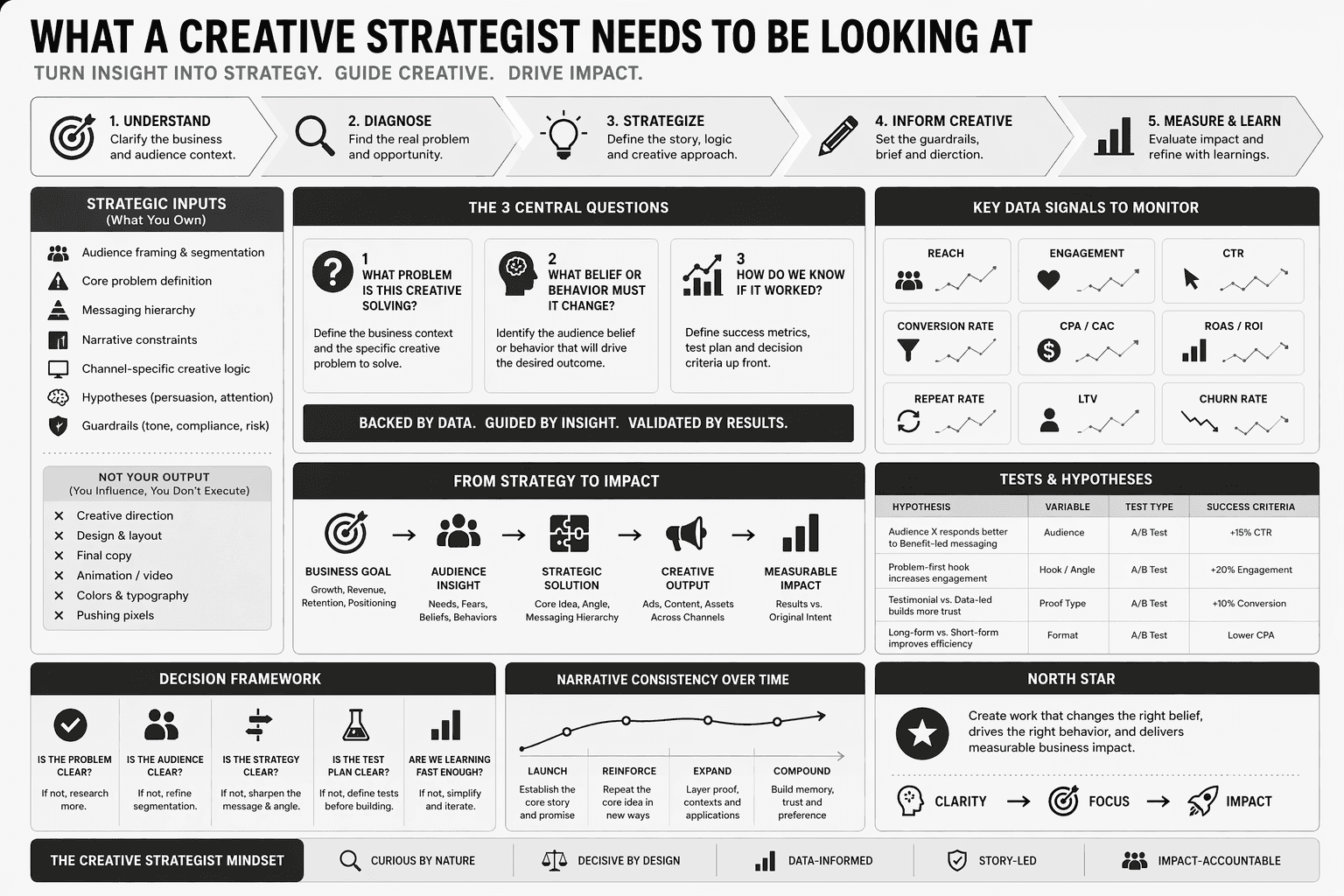
The Fastest Way to Understand the Role

One of the simplest ways to clarify the creative strategist's role is to separate inputs from outputs.

Strategic Inputs (What the Creative Strategist Owns)

Creative strategists own inputs. These are decisions that shape everything downstream.

Key inputs include:

  • Audience framing and segmentation logic

  • Core problem definition

  • Messaging hierarchy

  • Narrative constraints

  • Channel-specific creative logic

  • Hypotheses about persuasion and attention

  • Guardrails for tone, compliance and risk

These inputs should exist before design or copy begins. If creative starts before these are resolved, strategy has already failed.

Creative Outputs (What the Creative Strategist Does Not Own)

Creative strategists do not own outputs.

They do not:

  • Define the creative direction

  • Design assets

  • Write final copy

  • Animate videos

  • Choose colors or layouts

  • Push pixels

They influence these outputs through constraints and intent, not execution.

This distinction alone resolves most of the creative internal friction.

What Does a Creative Strategist Do Day to Day?

A common misconception is that creative strategy is abstract or philosophical. In reality, it is operational.

On a functional team, a creative strategist spends most of their time doing four things.

1. Translate Business Goals Into Creative Problems

Revenue targets, growth goals, churn issues, or positioning changes are not "creative" problems until someone identifies what that means.

A creative strategist takes a business goal and turns it into a creative problem worth solving.

For example:

  • “Increase conversions” becomes "what data can I access (or create) that identifies the creative that is stopping the scroll and increasing the click-through rate, what performed best, which ICP was targeted, is there a better audience we should be looking at, what we need to improve these numbers?" These are many questions, among many more, the Creative Strategist SHOULD be looking to answer.

That translation is strategic and needs to tell the creative team what to actually build in order to achieve the result.

2. Design the Decision Environment for Creative Teams

The strategist defines the rules of the game so creatives can play effectively.

That means answering:

  • What must be true for this to work?

  • What are we not allowed to do?

  • Where is experimentation encouraged versus constrained?

When this is done well, creative teams move faster.

3. Maintaining Narrative Consistency Across Time

Creative strategy is longitudinal. It cares about memory, not moments.

The strategist ensures that campaigns, posts, ads, and assets reinforce a coherent story instead of fragmenting attention.

This is where most teams fail, they optimize siloed assets without protecting meaning.

4. Interpret Signals Without Chasing Noise

Performance data is not strategy.

A creative strategist does not react to metrics. They interpret them through the lens of prior intent.

They ask:

  • Did this fail because the idea was wrong or the execution was weak?

  • Is this signal durable or situational?

  • What belief changed, if any?

Without this layer, teams enter a loop of endless back-and-forth - but usually don't reach any answers.

Creative Strategy and Creative Direction (the Line Most Teams Blur)

One of the most damaging misunderstandings is the distinction between creative strategy and creative direction.

They are complementary roles. They are not interchangeable.

Creative Strategy Is About Why and What

Creative strategy defines:

  • The problem

  • The audience lens

  • The narrative logic

  • The constraints

  • The success criteria

It operates upstream.

Creative Direction Is About How

Creative direction focuses on:

  • Visual language

  • Craft quality

  • Cohesion across assets

  • Aesthetic consistency

  • Executional excellence

It operates downstream.

When one person tries to fully own both, one of them collapses – usually the strategy.

Strategic Ownership Is the Missing Ingredient

Most teams say they have creative strategy.

What they actually have is creative opinion. Have you ever heard the saying, "feelings aren't facts"? Well, neither are opinions.

Strategic ownership means:

  • Someone is accountable for the thinking, not just the output

  • Decisions are documented and referenced

  • Trade-offs are explicit

  • Results are interpreted against original intent

Without ownership, strategy is decorative. This is why so many organizations “have” strategists but still feel directionless.

Why Most Teams Still Get the Creative Strategist Role Wrong

The failure patterns are remarkably consistent.

  • Strategy Is Introduced Too Late

    When strategy happens after concepts are created, it turns into justification instead of guidance.

  • Strategy Is Confused With Taste

    Being articulate about creative does not make someone a strategist. Strategy is about reasoning, not preference.

  • Strategy Is Treated as Support, Not Authority

    If strategists cannot say no, they are not strategists. They are consultants.

  • Strategy Is Measured by Output, Not Impact

    Counting decks, frameworks, or workshops is not a proxy for effectiveness.


What High-Functioning Teams Do Differently

Teams that get the creative strategist role right share a few traits.

  • Assign clear decision rights.

    Separate the stages of ideation and validation.

    View strategy as an evolving system rather than a one-time kickoff document.

    Honor creative autonomy while adhering to strategic boundaries.

Most importantly, they understand that speed comes from clarity.

The Creative Strategist Role in an AI-Heavy Creative World

AI has not diminished the creative strategist's role. It has sharpened it, but if execution becomes cheap and fast then the creative will not support the strategy correctly.

AI can generate options. It cannot decide which option matters, why it matters or how it compounds over time. That remains human work.

Make Creative Better with Brynga

In 2026, the teams that win are the ones who know why they are creating, what they are changing and how to tell if it worked.

Everything else risks being a waste.

At Brynga, this is what we do every day. We help teams get clear on why they are creating before they start making anything. That means less guesswork, less rework, and creative that actually works together instead of feeling random. Our strategy and production team build what that direction demands (ads, landing visuals, brand systems, content variations) and everything needed to execute with speed and consistency.

Instead of just handing you assets, you get a full creative team that shapes every piece of creative to support real growth goals. If your team is busy but things still feel messy or off-track, you don’t need more content. You need a system.

Get in touch with us and let’s build creative that moves your business forward.


FAQ: Creative Strategist Role

What is the primary responsibility of the creative strategist role?

The primary responsibility is owning the strategic logic behind creative decisions, including problem framing, data-supported decisions, messaging hierarchy, and success criteria.

What does a creative strategist do that a creative director does not?

A creative strategist defines why creative exists and what it must achieve. A creative director defines how it looks and feels.

Is the creative strategist role more analytical or creative?

It is neither. It is decisional. The role sits between insight, narrative, and judgment.

Can a small team afford a creative strategist?

Small teams often need the role more, not less. Without it, founders or marketers absorb the function informally, usually without clarity and experience. The best structure for companies moving into the AI era is to hire an in-house strategist and outsource creative direction and content production to teams like Brynga.

How do you measure success in the creative strategist role?

Success is measured by coherence, decision quality, reduced rework, and creative performance relative to original intent. A creative strategist isn’t measured by how many ideas they personally produce. They’re measured by what improves because they’re there:

  • Coherence: campaigns feel connected, not random

  • Decision quality: clearer briefs, stronger priorities, faster approvals

  • Reduced rework: fewer resets, fewer “make it pop” loops

  • Performance versus intent: creative results track back to the original goal (not just vanity metrics)

What's the best future-friendly setup for brand growth?

This structure fixes a common problem: the blurred line between creative strategy and creative direction. The strategist (whether ours or yours) focuses on the “what and why.” Brynga’s team owns the “how it comes to life” across channels. You get clarity and momentum (plus a fully loaded team) without paying for two in-house roles.

  • (Optional) A creative strategist in-house to own the business intent, audience insight, testing plan and decision-making fully supported by our team. Or, work with our strategist to define the best direction for your growth.

  • Partner with Brynga to supply the creative directors and production team that turns that strategy into high-performing ads and content, fast, consistently and without adding headcount.


For more than a decade, the creative strategist role has existed in a strange professional limbo. Everyone agrees it is important, but few teams agree on what it actually is. And even fewer organizations set teams up in a way that enables them to succeed.

Why the Creative Strategist Role Became So Confused

The creative strategist role did not evolve cleanly. As digital marketing scaled, teams realized that just “good creative” was not enough. Campaigns require a coherent story, but brands and performance have to be in sync. The problem is that the need for strategy was added without removing anything else.

Creative strategists were asked to:

  • Write briefs

  • Review copy

  • Influence design

  • Interpret performance

  • “Have ideas”

  • Explain why things worked or didn’t

The Creative Strategist Role in 2026

In 2026, the creative strategist role is not about taste, execution or personal creative ability.

It is about decision-making.

A creative strategist must lead the strategic logic behind creative output. That means they are accountable for why creative exists, not how it is executed.

At its core, the role answers three questions:

  1. What problem is this creative solving?

  2. What belief or behavior must it change?

  3. How do we know if it worked?

^ These questions must be answered through an efficient data-backed execution strategy for HOW the creative is utilized. And, which creative is needed, or works, to deliver the desired result(s).

What is a creative strategist?

A creative strategist is the go-between for business objectives and creative output in advertising.

They research and understand:

  • the brand (what it stands for, what it can credibly claim)

  • the competitors (what everyone else is saying and doing)

  • the audience (what they care about, what they fear, what they already believe)

Then they turn that information into insights and a clear strategic foundation, it helps the creative team do their job better. This means better briefs, stronger angles, clearer messaging, and campaign direction that’s tied to MEASURABLE outcomes.

A creative strategist sits between marketing strategy and creative execution to make sure ideas aren’t just “cool,” but actually work. – Riel Bo, Creative Director

As creative teams become more distributed, AI-assisted and performance-accountable, the lack of clarity around what a creative strategist does has become one of the biggest sources of inefficiency inside marketing and go-to-market (GTM) teams. Strategy, usually, gets either diluted into opinions or overloaded with execution, which means direction becomes reactive and creative output loses gravitas (I LOVE that I got to use that word).

The creative strategist role is an important part of high-performing teams today. Not as a vague hybrid between copy and design. But as a strategic owner with clear inputs, outputs, and decision authority.

The Fastest Way to Understand the Role

One of the simplest ways to clarify the creative strategist's role is to separate inputs from outputs.

Strategic Inputs (What the Creative Strategist Owns)

Creative strategists own inputs. These are decisions that shape everything downstream.

Key inputs include:

  • Audience framing and segmentation logic

  • Core problem definition

  • Messaging hierarchy

  • Narrative constraints

  • Channel-specific creative logic

  • Hypotheses about persuasion and attention

  • Guardrails for tone, compliance and risk

These inputs should exist before design or copy begins. If creative starts before these are resolved, strategy has already failed.

Creative Outputs (What the Creative Strategist Does Not Own)

Creative strategists do not own outputs.

They do not:

  • Define the creative direction

  • Design assets

  • Write final copy

  • Animate videos

  • Choose colors or layouts

  • Push pixels

They influence these outputs through constraints and intent, not execution.

This distinction alone resolves most of the creative internal friction.

What Does a Creative Strategist Do Day to Day?

A common misconception is that creative strategy is abstract or philosophical. In reality, it is operational.

On a functional team, a creative strategist spends most of their time doing four things.

1. Translate Business Goals Into Creative Problems

Revenue targets, growth goals, churn issues, or positioning changes are not "creative" problems until someone identifies what that means.

A creative strategist takes a business goal and turns it into a creative problem worth solving.

For example:

  • “Increase conversions” becomes "what data can I access (or create) that identifies the creative that is stopping the scroll and increasing the click-through rate, what performed best, which ICP was targeted, is there a better audience we should be looking at, what we need to improve these numbers?" These are many questions, among many more, the Creative Strategist SHOULD be looking to answer.

That translation is strategic and needs to tell the creative team what to actually build in order to achieve the result.

2. Design the Decision Environment for Creative Teams

The strategist defines the rules of the game so creatives can play effectively.

That means answering:

  • What must be true for this to work?

  • What are we not allowed to do?

  • Where is experimentation encouraged versus constrained?

When this is done well, creative teams move faster.

3. Maintaining Narrative Consistency Across Time

Creative strategy is longitudinal. It cares about memory, not moments.

The strategist ensures that campaigns, posts, ads, and assets reinforce a coherent story instead of fragmenting attention.

This is where most teams fail, they optimize siloed assets without protecting meaning.

4. Interpret Signals Without Chasing Noise

Performance data is not strategy.

A creative strategist does not react to metrics. They interpret them through the lens of prior intent.

They ask:

  • Did this fail because the idea was wrong or the execution was weak?

  • Is this signal durable or situational?

  • What belief changed, if any?

Without this layer, teams enter a loop of endless back-and-forth - but usually don't reach any answers.

Creative Strategy and Creative Direction (the Line Most Teams Blur)

One of the most damaging misunderstandings is the distinction between creative strategy and creative direction.

They are complementary roles. They are not interchangeable.

Creative Strategy Is About Why and What

Creative strategy defines:

  • The problem

  • The audience lens

  • The narrative logic

  • The constraints

  • The success criteria

It operates upstream.

Creative Direction Is About How

Creative direction focuses on:

  • Visual language

  • Craft quality

  • Cohesion across assets

  • Aesthetic consistency

  • Executional excellence

It operates downstream.

When one person tries to fully own both, one of them collapses – usually the strategy.

Strategic Ownership Is the Missing Ingredient

Most teams say they have creative strategy.

What they actually have is creative opinion. Have you ever heard the saying, "feelings aren't facts"? Well, neither are opinions.

Strategic ownership means:

  • Someone is accountable for the thinking, not just the output

  • Decisions are documented and referenced

  • Trade-offs are explicit

  • Results are interpreted against original intent

Without ownership, strategy is decorative. This is why so many organizations “have” strategists but still feel directionless.

Why Most Teams Still Get the Creative Strategist Role Wrong

The failure patterns are remarkably consistent.

  • Strategy Is Introduced Too Late

    When strategy happens after concepts are created, it turns into justification instead of guidance.

  • Strategy Is Confused With Taste

    Being articulate about creative does not make someone a strategist. Strategy is about reasoning, not preference.

  • Strategy Is Treated as Support, Not Authority

    If strategists cannot say no, they are not strategists. They are consultants.

  • Strategy Is Measured by Output, Not Impact

    Counting decks, frameworks, or workshops is not a proxy for effectiveness.


What High-Functioning Teams Do Differently

Teams that get the creative strategist role right share a few traits.

  • Assign clear decision rights.

    Separate the stages of ideation and validation.

    View strategy as an evolving system rather than a one-time kickoff document.

    Honor creative autonomy while adhering to strategic boundaries.

Most importantly, they understand that speed comes from clarity.

The Creative Strategist Role in an AI-Heavy Creative World

AI has not diminished the creative strategist's role. It has sharpened it, but if execution becomes cheap and fast then the creative will not support the strategy correctly.

AI can generate options. It cannot decide which option matters, why it matters or how it compounds over time. That remains human work.

Make Creative Better with Brynga

In 2026, the teams that win are the ones who know why they are creating, what they are changing and how to tell if it worked.

Everything else risks being a waste.

At Brynga, this is what we do every day. We help teams get clear on why they are creating before they start making anything. That means less guesswork, less rework, and creative that actually works together instead of feeling random. Our strategy and production team build what that direction demands (ads, landing visuals, brand systems, content variations) and everything needed to execute with speed and consistency.

Instead of just handing you assets, you get a full creative team that shapes every piece of creative to support real growth goals. If your team is busy but things still feel messy or off-track, you don’t need more content. You need a system.

Get in touch with us and let’s build creative that moves your business forward.


FAQ: Creative Strategist Role

What is the primary responsibility of the creative strategist role?

The primary responsibility is owning the strategic logic behind creative decisions, including problem framing, data-supported decisions, messaging hierarchy, and success criteria.

What does a creative strategist do that a creative director does not?

A creative strategist defines why creative exists and what it must achieve. A creative director defines how it looks and feels.

Is the creative strategist role more analytical or creative?

It is neither. It is decisional. The role sits between insight, narrative, and judgment.

Can a small team afford a creative strategist?

Small teams often need the role more, not less. Without it, founders or marketers absorb the function informally, usually without clarity and experience. The best structure for companies moving into the AI era is to hire an in-house strategist and outsource creative direction and content production to teams like Brynga.

How do you measure success in the creative strategist role?

Success is measured by coherence, decision quality, reduced rework, and creative performance relative to original intent. A creative strategist isn’t measured by how many ideas they personally produce. They’re measured by what improves because they’re there:

  • Coherence: campaigns feel connected, not random

  • Decision quality: clearer briefs, stronger priorities, faster approvals

  • Reduced rework: fewer resets, fewer “make it pop” loops

  • Performance versus intent: creative results track back to the original goal (not just vanity metrics)

What's the best future-friendly setup for brand growth?

This structure fixes a common problem: the blurred line between creative strategy and creative direction. The strategist (whether ours or yours) focuses on the “what and why.” Brynga’s team owns the “how it comes to life” across channels. You get clarity and momentum (plus a fully loaded team) without paying for two in-house roles.

  • (Optional) A creative strategist in-house to own the business intent, audience insight, testing plan and decision-making fully supported by our team. Or, work with our strategist to define the best direction for your growth.

  • Partner with Brynga to supply the creative directors and production team that turns that strategy into high-performing ads and content, fast, consistently and without adding headcount.

Professional woman in a suit standing in an office setting.

07

THE FIRST STEP

hit the ground running

We take a close look at your brand, offering and digital experience to uncover growth opportunities and give you a clear direction you can confidently move forward with.

"We don't guess. We define the steps, then we build."

– DIRECTOR OF PARTNERSHIPS, Riel Bo

Blurred black&white background
Professional woman in a suit standing in an office setting.

07

THE FIRST STEP

hit the ground running

We take a close look at your brand, offering and digital experience to uncover growth opportunities and give you a clear direction you can confidently move forward with.

"We don't guess. We define the steps, then we build."

– DIRECTOR OF PARTNERSHIPS, Riel Bo

Blurred black&white background
Professional woman in a suit standing in an office setting.

07

THE FIRST STEP

hit the ground running

We take a close look at your brand, offering and digital experience to uncover growth opportunities and give you a clear direction you can confidently move forward with.

"We don't guess. We define the steps, then we build."

– DIRECTOR OF PARTNERSHIPS, Riel Bo

Blurred black&white background

FORESIGHT

No fluff. Just sharp insights on brand, design and digital growth. Built for teams that want to move faster and perform better.

FORESIGHT

No fluff. Just sharp insights on brand, design and digital growth. Built for teams that want to move faster and perform better.

FORESIGHT

No fluff. Just sharp insights on brand, design and digital growth. Built for teams that want to move faster and perform better.

We're

READY TO

Start Your project

Every message that comes through this form is read by a real person on our team as soon as it arrives. No chatbots, no outsourced support and we get back to you within 2 business hours. Most of the time, right away. Try it and see.

Hi, Brynga team!

My name is

from

.

I need help with:

.

Budget:

$

Contact me at:

.

By submitting, you agree to our Terms and Privacy Policy.

Soft abstract gradient with white light transitioning into purple, blue, and orange hues

We're

READY TO

Start Your project

Every message that comes through this form is read by a real person on our team as soon as it arrives. No chatbots, no outsourced support and we get back to you within 2 business hours. Most of the time, right away. Try it and see.

Hi, Brynga team!

My name is

from

.

I need help with:

.

Budget:

$

Contact me at:

.

By submitting, you agree to our Terms and Privacy Policy.

Soft abstract gradient with white light transitioning into purple, blue, and orange hues
M
M
e
e
n
n
u
u

January 14, 2026

January 14, 2026

What a Creative Strategist Actually Does in 2026 (and Why Most Teams Get It Wrong)

A clear breakdown of what a creative strategist actually does, how it differs from creative direction and why this is the most valuable information for creatives this year.

A clear breakdown of what a creative strategist actually does, how it differs from creative direction and why this is the most valuable information for creatives this year.

For more than a decade, the creative strategist role has existed in a strange professional limbo. Everyone agrees it is important, but few teams agree on what it actually is. And even fewer organizations set teams up in a way that enables them to succeed.

Why the Creative Strategist Role Became So Confused

The creative strategist role did not evolve cleanly. As digital marketing scaled, teams realized that just “good creative” was not enough. Campaigns require a coherent story, but brands and performance have to be in sync. The problem is that the need for strategy was added without removing anything else.

Creative strategists were asked to:

  • Write briefs

  • Review copy

  • Influence design

  • Interpret performance

  • “Have ideas”

  • Explain why things worked or didn’t

The Creative Strategist Role in 2026

In 2026, the creative strategist role is not about taste, execution or personal creative ability.

It is about decision-making.

A creative strategist must lead the strategic logic behind creative output. That means they are accountable for why creative exists, not how it is executed.

At its core, the role answers three questions:

  1. What problem is this creative solving?

  2. What belief or behavior must it change?

  3. How do we know if it worked?

^ These questions must be answered through an efficient data-backed execution strategy for HOW the creative is utilized. And, which creative is needed, or works, to deliver the desired result(s).

What is a creative strategist?

A creative strategist is the go-between for business objectives and creative output in advertising.

They research and understand:

  • the brand (what it stands for, what it can credibly claim)

  • the competitors (what everyone else is saying and doing)

  • the audience (what they care about, what they fear, what they already believe)

Then they turn that information into insights and a clear strategic foundation, it helps the creative team do their job better. This means better briefs, stronger angles, clearer messaging, and campaign direction that’s tied to MEASURABLE outcomes.

A creative strategist sits between marketing strategy and creative execution to make sure ideas aren’t just “cool,” but actually work. – Riel Bo, Creative Director

As creative teams become more distributed, AI-assisted and performance-accountable, the lack of clarity around what a creative strategist does has become one of the biggest sources of inefficiency inside marketing and go-to-market (GTM) teams. Strategy, usually, gets either diluted into opinions or overloaded with execution, which means direction becomes reactive and creative output loses gravitas (I LOVE that I got to use that word).

The creative strategist role is an important part of high-performing teams today. Not as a vague hybrid between copy and design. But as a strategic owner with clear inputs, outputs, and decision authority.

The Fastest Way to Understand the Role

One of the simplest ways to clarify the creative strategist's role is to separate inputs from outputs.

Strategic Inputs (What the Creative Strategist Owns)

Creative strategists own inputs. These are decisions that shape everything downstream.

Key inputs include:

  • Audience framing and segmentation logic

  • Core problem definition

  • Messaging hierarchy

  • Narrative constraints

  • Channel-specific creative logic

  • Hypotheses about persuasion and attention

  • Guardrails for tone, compliance and risk

These inputs should exist before design or copy begins. If creative starts before these are resolved, strategy has already failed.

Creative Outputs (What the Creative Strategist Does Not Own)

Creative strategists do not own outputs.

They do not:

  • Define the creative direction

  • Design assets

  • Write final copy

  • Animate videos

  • Choose colors or layouts

  • Push pixels

They influence these outputs through constraints and intent, not execution.

This distinction alone resolves most of the creative internal friction.

What Does a Creative Strategist Do Day to Day?

A common misconception is that creative strategy is abstract or philosophical. In reality, it is operational.

On a functional team, a creative strategist spends most of their time doing four things.

1. Translate Business Goals Into Creative Problems

Revenue targets, growth goals, churn issues, or positioning changes are not "creative" problems until someone identifies what that means.

A creative strategist takes a business goal and turns it into a creative problem worth solving.

For example:

  • “Increase conversions” becomes "what data can I access (or create) that identifies the creative that is stopping the scroll and increasing the click-through rate, what performed best, which ICP was targeted, is there a better audience we should be looking at, what we need to improve these numbers?" These are many questions, among many more, the Creative Strategist SHOULD be looking to answer.

That translation is strategic and needs to tell the creative team what to actually build in order to achieve the result.

2. Design the Decision Environment for Creative Teams

The strategist defines the rules of the game so creatives can play effectively.

That means answering:

  • What must be true for this to work?

  • What are we not allowed to do?

  • Where is experimentation encouraged versus constrained?

When this is done well, creative teams move faster.

3. Maintaining Narrative Consistency Across Time

Creative strategy is longitudinal. It cares about memory, not moments.

The strategist ensures that campaigns, posts, ads, and assets reinforce a coherent story instead of fragmenting attention.

This is where most teams fail, they optimize siloed assets without protecting meaning.

4. Interpret Signals Without Chasing Noise

Performance data is not strategy.

A creative strategist does not react to metrics. They interpret them through the lens of prior intent.

They ask:

  • Did this fail because the idea was wrong or the execution was weak?

  • Is this signal durable or situational?

  • What belief changed, if any?

Without this layer, teams enter a loop of endless back-and-forth - but usually don't reach any answers.

Creative Strategy and Creative Direction (the Line Most Teams Blur)

One of the most damaging misunderstandings is the distinction between creative strategy and creative direction.

They are complementary roles. They are not interchangeable.

Creative Strategy Is About Why and What

Creative strategy defines:

  • The problem

  • The audience lens

  • The narrative logic

  • The constraints

  • The success criteria

It operates upstream.

Creative Direction Is About How

Creative direction focuses on:

  • Visual language

  • Craft quality

  • Cohesion across assets

  • Aesthetic consistency

  • Executional excellence

It operates downstream.

When one person tries to fully own both, one of them collapses – usually the strategy.

Strategic Ownership Is the Missing Ingredient

Most teams say they have creative strategy.

What they actually have is creative opinion. Have you ever heard the saying, "feelings aren't facts"? Well, neither are opinions.

Strategic ownership means:

  • Someone is accountable for the thinking, not just the output

  • Decisions are documented and referenced

  • Trade-offs are explicit

  • Results are interpreted against original intent

Without ownership, strategy is decorative. This is why so many organizations “have” strategists but still feel directionless.

Why Most Teams Still Get the Creative Strategist Role Wrong

The failure patterns are remarkably consistent.

  • Strategy Is Introduced Too Late

    When strategy happens after concepts are created, it turns into justification instead of guidance.

  • Strategy Is Confused With Taste

    Being articulate about creative does not make someone a strategist. Strategy is about reasoning, not preference.

  • Strategy Is Treated as Support, Not Authority

    If strategists cannot say no, they are not strategists. They are consultants.

  • Strategy Is Measured by Output, Not Impact

    Counting decks, frameworks, or workshops is not a proxy for effectiveness.


What High-Functioning Teams Do Differently

Teams that get the creative strategist role right share a few traits.

  • Assign clear decision rights.

    Separate the stages of ideation and validation.

    View strategy as an evolving system rather than a one-time kickoff document.

    Honor creative autonomy while adhering to strategic boundaries.

Most importantly, they understand that speed comes from clarity.

The Creative Strategist Role in an AI-Heavy Creative World

AI has not diminished the creative strategist's role. It has sharpened it, but if execution becomes cheap and fast then the creative will not support the strategy correctly.

AI can generate options. It cannot decide which option matters, why it matters or how it compounds over time. That remains human work.

Make Creative Better with Brynga

In 2026, the teams that win are the ones who know why they are creating, what they are changing and how to tell if it worked.

Everything else risks being a waste.

At Brynga, this is what we do every day. We help teams get clear on why they are creating before they start making anything. That means less guesswork, less rework, and creative that actually works together instead of feeling random. Our strategy and production team build what that direction demands (ads, landing visuals, brand systems, content variations) and everything needed to execute with speed and consistency.

Instead of just handing you assets, you get a full creative team that shapes every piece of creative to support real growth goals. If your team is busy but things still feel messy or off-track, you don’t need more content. You need a system.

Get in touch with us and let’s build creative that moves your business forward.


FAQ: Creative Strategist Role

What is the primary responsibility of the creative strategist role?

The primary responsibility is owning the strategic logic behind creative decisions, including problem framing, data-supported decisions, messaging hierarchy, and success criteria.

What does a creative strategist do that a creative director does not?

A creative strategist defines why creative exists and what it must achieve. A creative director defines how it looks and feels.

Is the creative strategist role more analytical or creative?

It is neither. It is decisional. The role sits between insight, narrative, and judgment.

Can a small team afford a creative strategist?

Small teams often need the role more, not less. Without it, founders or marketers absorb the function informally, usually without clarity and experience. The best structure for companies moving into the AI era is to hire an in-house strategist and outsource creative direction and content production to teams like Brynga.

How do you measure success in the creative strategist role?

Success is measured by coherence, decision quality, reduced rework, and creative performance relative to original intent. A creative strategist isn’t measured by how many ideas they personally produce. They’re measured by what improves because they’re there:

  • Coherence: campaigns feel connected, not random

  • Decision quality: clearer briefs, stronger priorities, faster approvals

  • Reduced rework: fewer resets, fewer “make it pop” loops

  • Performance versus intent: creative results track back to the original goal (not just vanity metrics)

What's the best future-friendly setup for brand growth?

This structure fixes a common problem: the blurred line between creative strategy and creative direction. The strategist (whether ours or yours) focuses on the “what and why.” Brynga’s team owns the “how it comes to life” across channels. You get clarity and momentum (plus a fully loaded team) without paying for two in-house roles.

  • (Optional) A creative strategist in-house to own the business intent, audience insight, testing plan and decision-making fully supported by our team. Or, work with our strategist to define the best direction for your growth.

  • Partner with Brynga to supply the creative directors and production team that turns that strategy into high-performing ads and content, fast, consistently and without adding headcount.

For more than a decade, the creative strategist role has existed in a strange professional limbo. Everyone agrees it is important, but few teams agree on what it actually is. And even fewer organizations set teams up in a way that enables them to succeed.

Why the Creative Strategist Role Became So Confused

The creative strategist role did not evolve cleanly. As digital marketing scaled, teams realized that just “good creative” was not enough. Campaigns require a coherent story, but brands and performance have to be in sync. The problem is that the need for strategy was added without removing anything else.

Creative strategists were asked to:

  • Write briefs

  • Review copy

  • Influence design

  • Interpret performance

  • “Have ideas”

  • Explain why things worked or didn’t

The Creative Strategist Role in 2026

In 2026, the creative strategist role is not about taste, execution or personal creative ability.

It is about decision-making.

A creative strategist must lead the strategic logic behind creative output. That means they are accountable for why creative exists, not how it is executed.

At its core, the role answers three questions:

  1. What problem is this creative solving?

  2. What belief or behavior must it change?

  3. How do we know if it worked?

^ These questions must be answered through an efficient data-backed execution strategy for HOW the creative is utilized. And, which creative is needed, or works, to deliver the desired result(s).

What is a creative strategist?

A creative strategist is the go-between for business objectives and creative output in advertising.

They research and understand:

  • the brand (what it stands for, what it can credibly claim)

  • the competitors (what everyone else is saying and doing)

  • the audience (what they care about, what they fear, what they already believe)

Then they turn that information into insights and a clear strategic foundation, it helps the creative team do their job better. This means better briefs, stronger angles, clearer messaging, and campaign direction that’s tied to MEASURABLE outcomes.

A creative strategist sits between marketing strategy and creative execution to make sure ideas aren’t just “cool,” but actually work. – Riel Bo, Creative Director

As creative teams become more distributed, AI-assisted and performance-accountable, the lack of clarity around what a creative strategist does has become one of the biggest sources of inefficiency inside marketing and go-to-market (GTM) teams. Strategy, usually, gets either diluted into opinions or overloaded with execution, which means direction becomes reactive and creative output loses gravitas (I LOVE that I got to use that word).

The creative strategist role is an important part of high-performing teams today. Not as a vague hybrid between copy and design. But as a strategic owner with clear inputs, outputs, and decision authority.

The Fastest Way to Understand the Role

One of the simplest ways to clarify the creative strategist's role is to separate inputs from outputs.

Strategic Inputs (What the Creative Strategist Owns)

Creative strategists own inputs. These are decisions that shape everything downstream.

Key inputs include:

  • Audience framing and segmentation logic

  • Core problem definition

  • Messaging hierarchy

  • Narrative constraints

  • Channel-specific creative logic

  • Hypotheses about persuasion and attention

  • Guardrails for tone, compliance and risk

These inputs should exist before design or copy begins. If creative starts before these are resolved, strategy has already failed.

Creative Outputs (What the Creative Strategist Does Not Own)

Creative strategists do not own outputs.

They do not:

  • Define the creative direction

  • Design assets

  • Write final copy

  • Animate videos

  • Choose colors or layouts

  • Push pixels

They influence these outputs through constraints and intent, not execution.

This distinction alone resolves most of the creative internal friction.

What Does a Creative Strategist Do Day to Day?

A common misconception is that creative strategy is abstract or philosophical. In reality, it is operational.

On a functional team, a creative strategist spends most of their time doing four things.

1. Translate Business Goals Into Creative Problems

Revenue targets, growth goals, churn issues, or positioning changes are not "creative" problems until someone identifies what that means.

A creative strategist takes a business goal and turns it into a creative problem worth solving.

For example:

  • “Increase conversions” becomes "what data can I access (or create) that identifies the creative that is stopping the scroll and increasing the click-through rate, what performed best, which ICP was targeted, is there a better audience we should be looking at, what we need to improve these numbers?" These are many questions, among many more, the Creative Strategist SHOULD be looking to answer.

That translation is strategic and needs to tell the creative team what to actually build in order to achieve the result.

2. Design the Decision Environment for Creative Teams

The strategist defines the rules of the game so creatives can play effectively.

That means answering:

  • What must be true for this to work?

  • What are we not allowed to do?

  • Where is experimentation encouraged versus constrained?

When this is done well, creative teams move faster.

3. Maintaining Narrative Consistency Across Time

Creative strategy is longitudinal. It cares about memory, not moments.

The strategist ensures that campaigns, posts, ads, and assets reinforce a coherent story instead of fragmenting attention.

This is where most teams fail, they optimize siloed assets without protecting meaning.

4. Interpret Signals Without Chasing Noise

Performance data is not strategy.

A creative strategist does not react to metrics. They interpret them through the lens of prior intent.

They ask:

  • Did this fail because the idea was wrong or the execution was weak?

  • Is this signal durable or situational?

  • What belief changed, if any?

Without this layer, teams enter a loop of endless back-and-forth - but usually don't reach any answers.

Creative Strategy and Creative Direction (the Line Most Teams Blur)

One of the most damaging misunderstandings is the distinction between creative strategy and creative direction.

They are complementary roles. They are not interchangeable.

Creative Strategy Is About Why and What

Creative strategy defines:

  • The problem

  • The audience lens

  • The narrative logic

  • The constraints

  • The success criteria

It operates upstream.

Creative Direction Is About How

Creative direction focuses on:

  • Visual language

  • Craft quality

  • Cohesion across assets

  • Aesthetic consistency

  • Executional excellence

It operates downstream.

When one person tries to fully own both, one of them collapses – usually the strategy.

Strategic Ownership Is the Missing Ingredient

Most teams say they have creative strategy.

What they actually have is creative opinion. Have you ever heard the saying, "feelings aren't facts"? Well, neither are opinions.

Strategic ownership means:

  • Someone is accountable for the thinking, not just the output

  • Decisions are documented and referenced

  • Trade-offs are explicit

  • Results are interpreted against original intent

Without ownership, strategy is decorative. This is why so many organizations “have” strategists but still feel directionless.

Why Most Teams Still Get the Creative Strategist Role Wrong

The failure patterns are remarkably consistent.

  • Strategy Is Introduced Too Late

    When strategy happens after concepts are created, it turns into justification instead of guidance.

  • Strategy Is Confused With Taste

    Being articulate about creative does not make someone a strategist. Strategy is about reasoning, not preference.

  • Strategy Is Treated as Support, Not Authority

    If strategists cannot say no, they are not strategists. They are consultants.

  • Strategy Is Measured by Output, Not Impact

    Counting decks, frameworks, or workshops is not a proxy for effectiveness.


What High-Functioning Teams Do Differently

Teams that get the creative strategist role right share a few traits.

  • Assign clear decision rights.

    Separate the stages of ideation and validation.

    View strategy as an evolving system rather than a one-time kickoff document.

    Honor creative autonomy while adhering to strategic boundaries.

Most importantly, they understand that speed comes from clarity.

The Creative Strategist Role in an AI-Heavy Creative World

AI has not diminished the creative strategist's role. It has sharpened it, but if execution becomes cheap and fast then the creative will not support the strategy correctly.

AI can generate options. It cannot decide which option matters, why it matters or how it compounds over time. That remains human work.

Make Creative Better with Brynga

In 2026, the teams that win are the ones who know why they are creating, what they are changing and how to tell if it worked.

Everything else risks being a waste.

At Brynga, this is what we do every day. We help teams get clear on why they are creating before they start making anything. That means less guesswork, less rework, and creative that actually works together instead of feeling random. Our strategy and production team build what that direction demands (ads, landing visuals, brand systems, content variations) and everything needed to execute with speed and consistency.

Instead of just handing you assets, you get a full creative team that shapes every piece of creative to support real growth goals. If your team is busy but things still feel messy or off-track, you don’t need more content. You need a system.

Get in touch with us and let’s build creative that moves your business forward.


FAQ: Creative Strategist Role

What is the primary responsibility of the creative strategist role?

The primary responsibility is owning the strategic logic behind creative decisions, including problem framing, data-supported decisions, messaging hierarchy, and success criteria.

What does a creative strategist do that a creative director does not?

A creative strategist defines why creative exists and what it must achieve. A creative director defines how it looks and feels.

Is the creative strategist role more analytical or creative?

It is neither. It is decisional. The role sits between insight, narrative, and judgment.

Can a small team afford a creative strategist?

Small teams often need the role more, not less. Without it, founders or marketers absorb the function informally, usually without clarity and experience. The best structure for companies moving into the AI era is to hire an in-house strategist and outsource creative direction and content production to teams like Brynga.

How do you measure success in the creative strategist role?

Success is measured by coherence, decision quality, reduced rework, and creative performance relative to original intent. A creative strategist isn’t measured by how many ideas they personally produce. They’re measured by what improves because they’re there:

  • Coherence: campaigns feel connected, not random

  • Decision quality: clearer briefs, stronger priorities, faster approvals

  • Reduced rework: fewer resets, fewer “make it pop” loops

  • Performance versus intent: creative results track back to the original goal (not just vanity metrics)

What's the best future-friendly setup for brand growth?

This structure fixes a common problem: the blurred line between creative strategy and creative direction. The strategist (whether ours or yours) focuses on the “what and why.” Brynga’s team owns the “how it comes to life” across channels. You get clarity and momentum (plus a fully loaded team) without paying for two in-house roles.

  • (Optional) A creative strategist in-house to own the business intent, audience insight, testing plan and decision-making fully supported by our team. Or, work with our strategist to define the best direction for your growth.

  • Partner with Brynga to supply the creative directors and production team that turns that strategy into high-performing ads and content, fast, consistently and without adding headcount.


Professional woman in a suit standing in an office setting.

07

THE FIRST STEP

hit the ground running

We take a close look at your brand, offering and digital experience to uncover growth opportunities and give you a clear direction you can confidently move forward with.

"We don't guess. We define the steps, then we build."

– DIRECTOR OF PARTNERSHIPS, Riel Bo

Blurred black&white background
Professional woman in a suit standing in an office setting.

07

THE FIRST STEP

hit the ground running

We take a close look at your brand, offering and digital experience to uncover growth opportunities and give you a clear direction you can confidently move forward with.

"We don't guess. We define the steps, then we build."

– DIRECTOR OF PARTNERSHIPS, Riel Bo

Blurred black&white background
Professional woman in a suit standing in an office setting.

07

THE FIRST STEP

hit the ground running

We take a close look at your brand, offering and digital experience to uncover growth opportunities and give you a clear direction you can confidently move forward with.

"We don't guess. We define the steps, then we build."

– DIRECTOR OF PARTNERSHIPS, Riel Bo

Blurred black&white background

FORESIGHT

No fluff. Just sharp insights on brand, design and digital growth. Built for teams that want to move faster and perform better.

FORESIGHT

No fluff. Just sharp insights on brand, design and digital growth. Built for teams that want to move faster and perform better.

FORESIGHT

No fluff. Just sharp insights on brand, design and digital growth. Built for teams that want to move faster and perform better.

We're

READY TO

Start Your project

Every message that comes through this form is read by a real person on our team as soon as it arrives. No chatbots, no outsourced support and we get back to you within 2 business hours. Most of the time, right away. Try it and see.

Hi, Brynga team!

My name is

from

I need help with:

Budget:

Contact me at:

By submitting, you agree to our Terms and Privacy Policy.

Soft abstract gradient with white light transitioning into purple, blue, and orange hues